
Chapter 6: Recovery Guidelines and Documentation
IN THIS LESSON
When AROM and PROM are similar and restricted, it indicates that the limitation is not primarily due to a problem with muscle, but rather to an issue within the joint itself. The pain is not originating from a damaged tissue that needs to heal; instead, it's stemming from a faulty movement pattern or joint mechanics.
The absence of neural signs helps rule out a neck-related nerve entrapment issue as the primary source of Bob's shoulder pain.
The hesitancy and tenderness on manual muscle testing are a protective response to the underlying joint dysfunction. These findings suggests that the muscle is not inherently weak or torn. The nervous system is guarding the joint by limiting muscle contraction and causing pain.
A pliable and tender end feel points to a capsular or ligamentous restriction. This is a hallmark sign of a mechanical dysfunction, where the joint surfaces are not rolling correctly.
-
Sleep is interrupted, pain when reaching behind his back, decreased strength when serving the tennis ball, activity level has decreased.
-
I am going to suggest splitting the Objective section of the OG SOAP note into 3 sections: Pre-Treatment, Treatment and Post-Treatment. This way, you can better document change over time - a key to recovery.
-
Bob presents with left shoulder active ROM tight and tender at end range. He says there is no numbness or tingling down his left arm. No swelling or bruising is present at left shoulder.
The MMT resistance testing of his left shoulder presence as hesitant and tender left shoulder ER and abduction, strong and painless left shoulder IR and adduction. No tenderness with palpation biceps tendon and MMT resistance of left biceps is strong and painless.
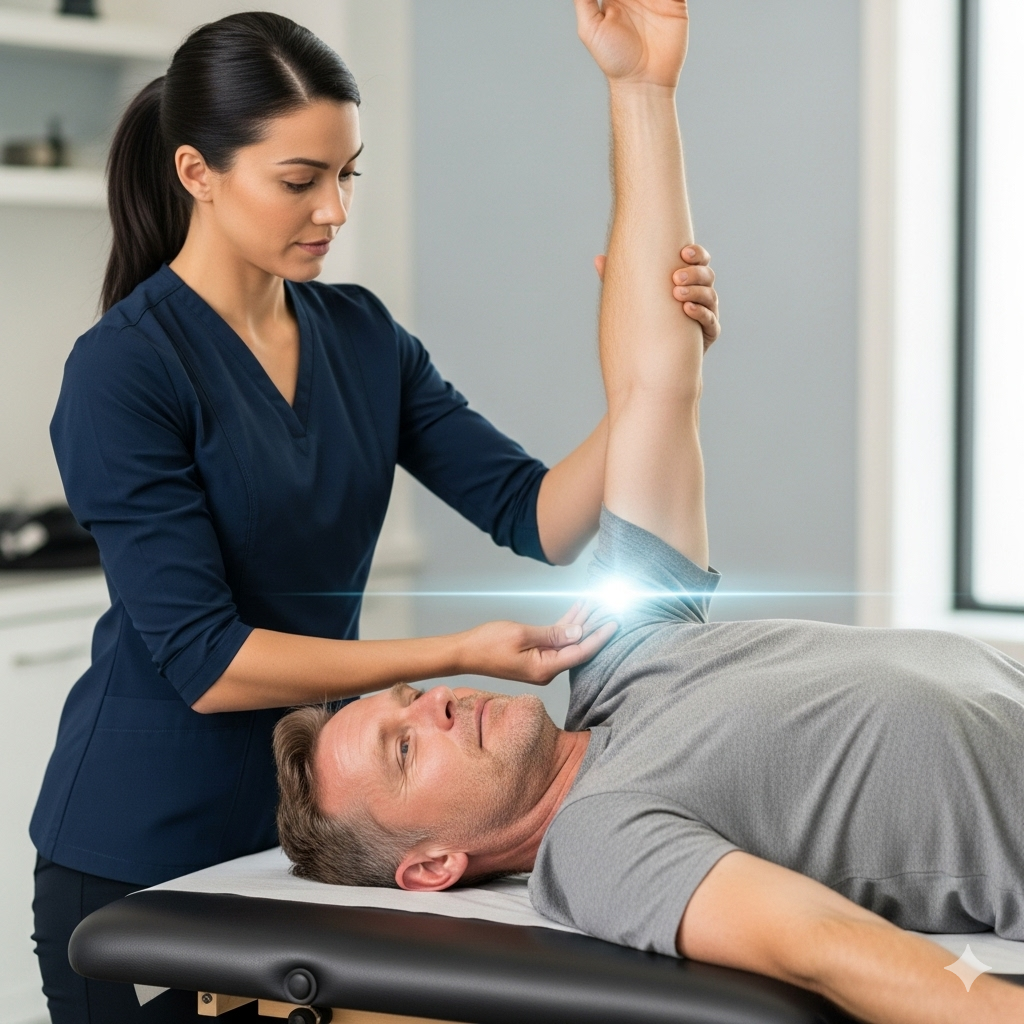
Passive ROM of left shoulder is tender, tight and pliable at end range elevation, supine. Left cervicothoracic side-bend and right rotation presents with a moderate tightness.
There is a moderate mechanical dysfunction left C5-6-7-T1-2-3-4-5-6, and a mild mechanical dysfunction left glenohumeral joint.
-
Facilitation of normal joint movement to decrease cervicothoracic and left shoulder mechanical joint dysfunction.
-
spontaneous decrease spasm
increase cervicothoracic side bend and rotation
increase passive and active shoulder elevation
spontaneous decrease irritation reaching
-
Client tolerated treatment well. He presented with moderate cervicothoracic and shoulder mechanical dysfunction and related spasm and irritation. He knew a difference right after treatment with increase ease of reaching.
-
continue to address mechanical dysfunction and shoulder motion. address movement control and power as appropriate. Monitor full return to tennis.